


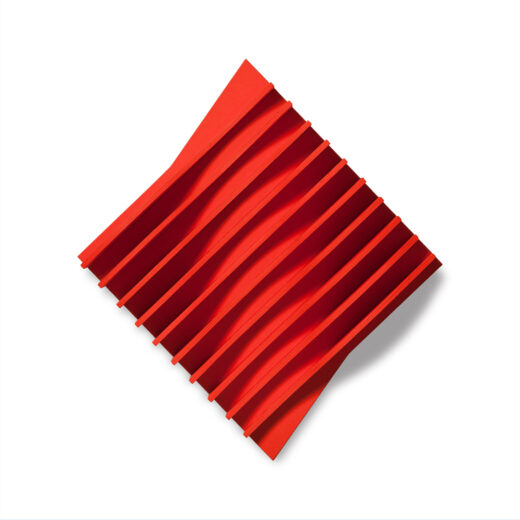
 Born in Santa Croce di Magliano (Campobasso) on 04.06.1957 where he lives and works.
He is an architect, artist and designer.
He studied architecture at the Sapienza University of Rome. A pupil of Filiberto Menna, after an initial conceptual phase, in 1996 through Anna Canali, director of the Galleria Arte Struktura in Milan, he joined the MADI, an international movement, founded in 1946 in Buenos Aires by Carmelo Arden Quin, attributable to non-cultural artistic research figurative through non-expressive, non-representative and non-symbolic forms..
ACHILLE PACE FOR VINCENZO MASCIA
Mascia has an undoubted interest in “constructivist” techniques, that is, in all those techniques that have a relationship and relevance with the rational design techniques of a productivist social reality.
But if society plans consumption and quantity, Mascia plans quality and uniqueness, if the system wants the obsolescence of the object, Mascia tends towards duration and the subject.
Observing his commitment to a correct measurement of formal proportionality, the balance of the parts of the painting, the essentiality and rigor of the signs, one realizes how everything tends towards a formal reality which is found in the structural idea of the spatial image , the justification of its relationship with the world of production as value.
By eliminating every useless adjective and everything that is instinctual, while remaining spontaneous, he manages to conceive the painting as a model that is at once formal order, proportional metric and unity of the contrasting parts.
In short, Mascia, more than convincing us with feelings and sensations, wants to persuade us through rational thought. And this is no small thing today when we live in a problematic moment due to the crisis that “reason” is going through.
By using very difficult and dangerous instruments, precisely because of the rarefaction of subjective and passionate contents, he risks a lot, especially with regards to communication.
But if the rigor and rhythm are maintained in the right and harmonious measure and tension, he will be able to continue with this poetics to the end, following his formative vein with sincerity. It must be taken into account that Mascia studied architecture and therefore “design”.
But we must be careful not to confuse the sign of the architectural project with the sign of the painter, because if the architectural project refers to something that is outside of it, which will be realized later, the painter’s “project” is real in itself, it does not refer to what happens afterwards, but to what is in that moment, and therefore it must have an end value in itself, complete, significant.
Precisely for this reason the poetics of the “sign” seems to be, for now, what most engages Mascia’s work.
Signs sought from time to time and articulated in the relationships of encounter-clash, concave-convex, positive-negative, where a subtle relationship of white on white indicates a vibration of light, sometimes contrasted by a strong primary color that attracts itself the directional movement of the composition.
The neutral surface, or pause in the background, does not intend to have a direct relationship with the signs that are above it, but more precisely to establish an allusive interval of external, continuous reality, so that the painting is not closed in a delimiting frame, but can be expand to real, external space. Note the continuous support of the signs at the margins of the painting from which they begin.
His paintings lack any hint of a centre, or three-dimensional perspective convergence, in which the signs relate to each other.
All that remains is a conversation of attraction and repulsion of the individual autonomous elements. Space does not want to be a visual infinity, but an infinity of forces in continuous balance.
Mascia uses a technique that requires external direction on the “visual patterns”, and precisely for this reason, an articulated, careful and tense workmanship of the signs is more important than ever, which signs, being unique and protagonists, are valid for their sharpness and declared accuracy.
An elementary but difficult, extremely mental quest, where everything is played with the risk of losing. But precisely for this reason his work deserves encouragement, so that it can continue and progress in the direction of quality, purity of signs and civility of language.
August 1984
Achille Pace
VINCENZO MASCIA | LIGHT AND COLOR BEYOND THE SURFACE
by Cristina Costanzo
“I don’t feel like a painter, but rather a designer. I conceive my works as prototypes of serial production. A design object is all the more true the more it enters our everyday life without distorting it. In my works in the same way I seek banality. The object accompanies our life with its anonymous, silent and reassuring presence”.
Vincenzo Mascia, 1995
Vincenzo Mascia, a complex figure of architect, artist and designer, is a significant exponent of the International Madi Movement.
Trained in Rome at the Faculty of Architecture of Valle Giulia, where he came into contact with Filiberto Menna, theorist of analytical painting, Mascia soon turned to non-figurative art with particular attention to the results of Dutch Neoplasticism, the Russian Avant-garde, ‘Conceptual and Concrete Art. Of great importance is the comparison with the masters of the 20th century such as Lucio Fontana, inspirer of the cycle of works On the trail of Fontana, everted structures created by engraving cardboard surfaces with measured and rational signs, which reveal a colored background to “finding light and color beyond the surface”. In the early reflections, the characteristic orientations of Mascia’s production are identified: the crossing of boundaries between different artistic fields and expressive forms and the projection of the work into space to be understood both as the culture of the object and as art in the environment. It is no coincidence, therefore, that since his university years (1976-1982) Mascia has been fascinated by design and has approached the study of personalities such as Gerrit Thomas Rietveld, Charles Rennie Mackintosh and Le Corbusier. At the end of the 80s the passion for design converged in ART DESIGN, a company dedicated to the production of objects and furnishing accessories designed by our artist. The series of works inspired by Memphis, a design and architecture collective founded by Ettore Sottsass, dates back to this experience. These are objects – clocks, benches, tables, shop windows, mirrors and more – characterized by the presence of abstract volumes in the foreground that are articulated with the geometric surfaces of the background. This activity contributes to defining Mascia’s aspiration to create objects with their own identity, detached from the mimetic interpretation of reality.
In 1996, frequenting the Milanese cultural environment and in particular the relationships with the Galleria Arte Struktura, directed by Anna Canali, favored Mascia’s membership of the MADI, an international movement founded in 1946 in Buenos Aires by Carmelo Arden Quin, attributable to the non-figurative artistic research through non-expressive, non-representative and non-symbolic forms. Mascia thus arrives at a production free from the constraints of the mimetic interpretation of reality, characterized by everted objects, articulated with joints and unusual geometries. In the footsteps of Carmelo Arden Quin, Mascia’s research, in an effective balance between freedom and play, contributes to the emancipation of the work from the frame. The intervention conceived for I-Design, an international event designed by Daniela Brignone, which reached its fourth edition in 2015, turns out to be particularly representative of Mascia’s research on Chaotic Structure. The primary elements of the work are the colored aluminum tubulars arranged randomly, according to juxtapositions and overlaps, and placed in Piazza Politeama in Palermo. The work includes the presence of a mirrored surface, capable of communicating with the surrounding environmental context and revealing the unprecedented possibilities of interaction between art, design and architecture. Mascia, underlines Serena Mormino, is “an artist of well-defined geometric shapes and decompositions even when broken down” and is “a designer, because the playful and playful art typically Madì can also have a function in everyday life”. Mascia implements an overcoming of painting understood in the traditional sense and operates a synthesis of the artistic discipline with architecture and design in order to achieve, as he declared, “the harmony of contrasting parts: order and disorder, solids and voids , shiny and opaque, concave and convex”. Mascia’s success, sealed by the attention of critics and the public found during the numerous personal and collective exhibitions in Italy and abroad, lies precisely in the union of thought and phenomenon and in the ability to cross the border between the idea and the action, the concept and the everyday, in harmony with his works made of light and color beyond the surface.
INTERVIEW WITH VINCENZO MASCIA
by Valentina Lucia Barbagallo
Chi è Vincenzo Mascia? Ci parli, se le va, non solo di lei come artista, designer ma anche di lei come uomo.
Who is Vincenzo Mascia? Tell us, if you like, not only about yourself as an artist, designer but also about you as a man.
I believe that interviews are the best way to learn about the personalities of men in general and artists in particular. I, who am inclined towards synthesis, in the sense that I like to understand things quickly and possibly with minimal effort, find more information in an interview than in an entire treatise. Who I am? I often ask myself this and I also often ask myself the meaning of what I do, and almost always I don’t find answers. I am a deeply and proudly Southern man, I love the Mediterranean light, the sea, I am from Molise from Santa Croce di Magliano, of proletarian extraction it would have been said once upon a time. Professional high schools, technical institute for surveyors, obviously, my father was a construction carpenter, with a dormant vocation for beauty and art. Lover of pop music, Lucio Battisti for Italian authors, Beatles for foreign music, apparently so distant, but so close in the evolution of new sounds, with visions of synthesis, of reducing chords, instruments, harmonizations to a minimum. Curiosity and the desire to grow, culturally and also socially, led me to enroll in the architecture faculty of Valle Giulia, the mythical city of the 1968 revolution, in the Rome of the dark years of lead, but also of the joy of the student movement, of creativity in power, of metropolitan Indians. During my stay in Rome, from an artistic point of view, two things deeply impressed me: attending the course of art history institutions with Filiberto Menna, theorist of the analytical current, and an exhibition that I saw in a private gallery in Piazza Fontanella Borghese in Piero Manzoni. I asked myself, is Piero Manzoni a genius or is he here with his works to make fun of others. This time there were no shortcuts or simplifications, to understand Manzoni it was necessary to study post-Duchampian conceptual and analytical painting. Manzoni reflected on art as an autonomous language and, provocatively, like the Sex Pistols in music, he demonstrated that great art or great music could be made even without knowing the techniques in depth, that the content of the container, the meaning of the signifier, matters more.
I understood that with four chords you can write great music and I decided that I would try to be an artist.
Architecture and visual art: how much and how do these two disciplines filter/guide your gaze and your vision of things?
I belong to the great international Madì Movement, a direct consequence of the constructivism to which it is intimately connected. Built art, moving from linguistic and formal zeroing (no form exists a priori: it takes shape with the art of building, putting together, composing), breaks with the historicist tradition and creates continuity between art and technology. This intimate connection with other disciplines (architecture, graphics, industrial design) means that it is still a stubbornly vital art. So basically my vision of the world and things is connected to my studies in art and architecture, there is no discontinuity between art, architecture and design.
Do you consider yourself more of an artist or a designer?
Personally, I have never had an interest in painting in the traditional sense, I’m not one of those who filled notebooks with drawings at the age of five. I am immensely in love with art, but above all with architecture and design, I have always sought a synthesis between these disciplines, because ultimately the methodology, the approach is identical.
Full empty; horizontal Vertical; shiny – opaque: they are oxymoronic couples that always return in his works and which almost seem to be the generating forces of his own research. How?
Life itself, the universe is the set of contrasting forces: matter and antimatter, order and disorder, male and female, dark and light, life and death, good and evil, Yin and Yang. Architecture also pursues the balance of contrasts, Munari dedicates an entire phase of his research to the positive – negative.
Man always lives in this perennial contrast, in this dialectic of opposites, between the irrational impulse and the rational order.
My works, in their apparent disorder, have their ultimate goal in the search for harmony.
What is the relationship between your membership of the Madì movement and your personal research?
As an artist I am part of an artistic movement that for decades has pursued an art that does not represent, does not mean, and does not refer to symbols. Art is here and now with its linguistic autonomy with its code and its set of signs. The artistic object does not refer to anything other than itself but is self-significant, that is, the signifier and the signified are perfectly coincident. Carmelo Arden Quin, founder of Madì with Rhod Rothfuss and Gyula Kosice, frees the painting from the yoke of the frame and the tyranny of elementary forms, while remaining profoundly linked to painting.
I arrived at Madì in 1996 unconsciously. Working for a long time on the cycle of works entitled “on the trail of Fontana”, engraved and everted cardboard surfaces that revealed a background of color and light, at a certain point I realized that it was necessary to go beyond the limits of the outline of the painting which now appeared to me like a universe in itself, concluded, which did not allow dialogue or contamination.
I wanted the painting to explode into a thousand fragments, to overcome its limits and try to conquer the space outside of itself. So I began to work on breaking down the square into other elementary geometric shapes that I assembled by juxtaposition or superposition.
In 2015 I created installations at the Portofino Park Museum, in Venice for Open 18, in Palermo in Piazza Politeama in Palermo, using a square aluminum tubular as the primary element, I used nine of them, arranged randomly on the ground in juxtaposition and in overlap (the possible combinations are infinite) in a sort of maxi mikado, in continuity with the Madì thought of a playful and playful art.
The strips are colored at the end, to make them unique and subjectivise them.
The slats rest on a mirrored steel sheet, so that it reflects part of the slats and the sky, nature and the surrounding landscape. The change in light conditions and atmospheric conditions introduces a fourth dimension of the work, the temporal one, establishing the limit between nature and artifice, between nature and culture.
What advice would you give to those who would like to pursue your profession today?
I don’t feel like pointing out ways or dispensing advice, everyone must live their own life and cultivate their own dreams. I may be the last of the artists but I see too much approximation around, too many people who feel like the misunderstood artist who sooner or later will be recognized as the new Van Gogh. And unfortunately around this galaxy of alleged artists there are equally alleged experts, critics or gallery owners who make you see the moon in the well, just pay the ticket and they will get you a nail where you can hang your art and wait for the enlightened gallery owner to arrive who will give you money and fame. I often reflect: but whoever makes it happen by staying closed in my laboratory, in the heat or the cold depending on the season, for years and years of continuous research, of self-financing, of frustrations, of bitterness, of renunciations, wouldn’t it be better to do a nice walk, going to the beach, playing cards with friends, but it’s the fire of art that envelops and destroys us.e.
GIORGIO AGNISOLA FOR MASCIA
Vincenzo Mascia, the further balance
Vincenzo Mascia’s art is not simply constructive, it does not end in a rationalistic reading of reality, filtered by personal aesthetic feelings. Undoubtedly the artist pursues an idea of structure, characterized by a logic applied in particular to the relationship between the parts, frequently placing visual perception at the basis of his projects. And yet in many of his works there is something more and different. The order, the measure seem to be the result of a sort of lively psychological and mental apprehension, connected with a more internal warning of artistic making. Thanks to which Mascia remains vigilant, intuition after intuition, to grasp that limit of the form freed from all temporariness, definitively returned to a sort of superior harmony.
That Mascia’s art is not a pure mechanistic construction can be seen by analyzing the ways and techniques of his work. In fact, the artist sometimes achieves balance by breaking the purely consequential rhythm of the signs and formal elements he uses, inserting an element of discontinuity into the image. Other times it composes a static structure but prefigures the dynamic one, as in many works in this exhibition, characterized by a sort of wave of the gaze, which supports the spiritual wave of the observer. Other times the artist’s intent is to capture the point of synthesis between balance and imbalance of forms, achieving a visual structure with a strong spiritual connotation. Finally, other times Mascia plays with colours, which he evokes like light, finely, in relation to their wavelength. It is from this variation of procedures that we first grasp the waiting, the vigilance, the recurrence but also the improvisation of a measured, but also tense and intuitive action.
Leaning towards a further feeling of life.
Giorgio Agnisola 2016


